

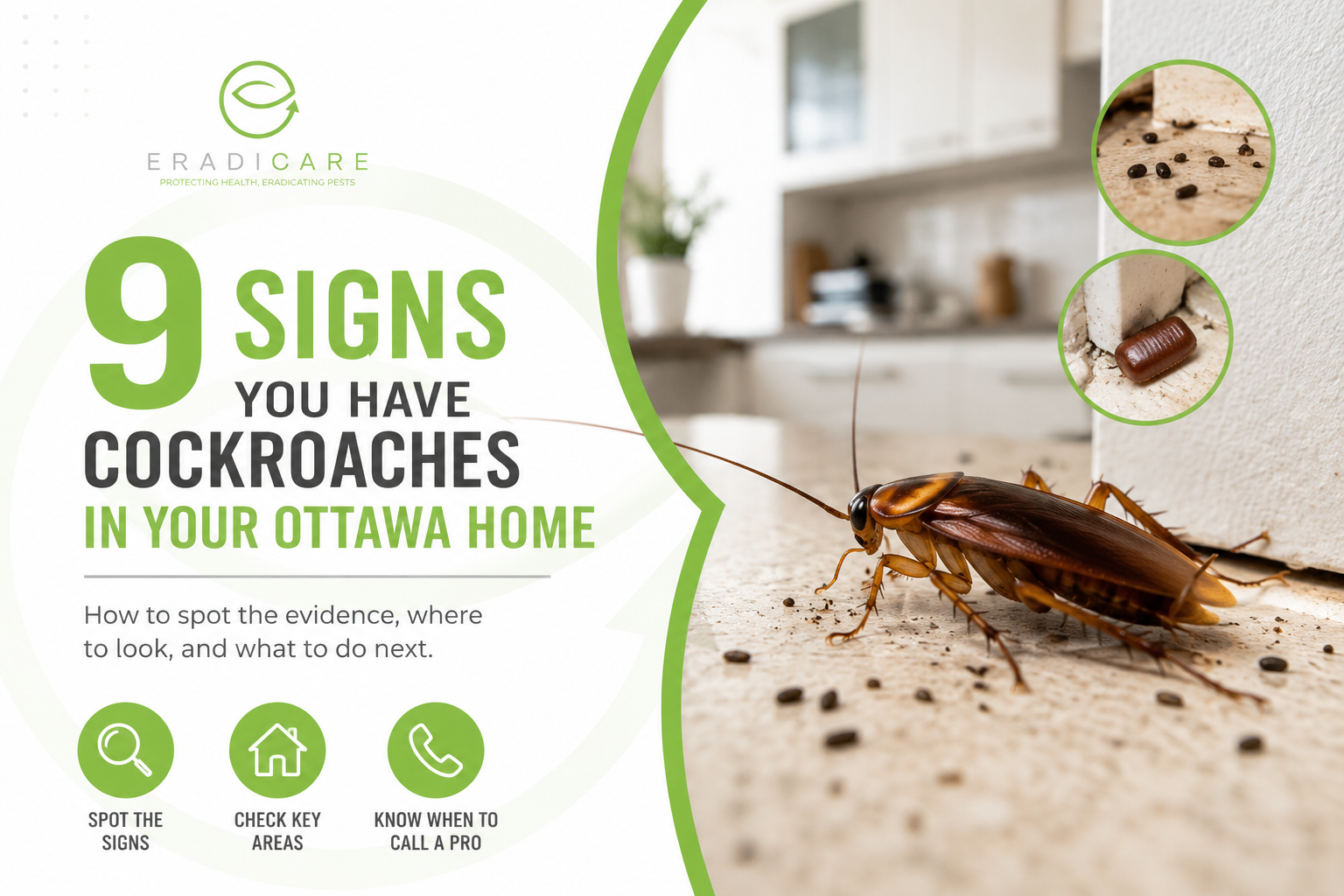
Seeing a cockroach is an obvious warning sign, but live insects aren’t the only evidence to look for. Small dark droppings, egg cases, immature cockroaches, shed skins, and repeated activity near food or moisture can also point to a hidden problem.
If you live in Ottawa and have noticed something suspicious in your kitchen, bathroom, or another part of your home, the pattern of evidence matters. One unexplained insect tells you far less than repeated sightings or several signs in the same area.
Here are nine common signs of cockroaches, where to check for hidden activity, and what to do if the evidence keeps appearing.
What Are the Most Common Signs of Cockroaches?
Cockroach signs can reveal where the insects are traveling, feeding, or hiding. A single clue may not show how much activity is present, but several signs in the same area give you more to work with.
1. Live Cockroaches, Especially Repeated Sightings
Repeated cockroach sightings are a clear reason to investigate further.
Cockroaches often stay in protected hiding areas during the day and become more active when the surroundings are quiet. Many people first spot one crossing a kitchen floor after turning on the lights at night.
One cockroach does not automatically mean you have a large infestation. It also doesn’t tell you where the insect came from or how much activity may be hidden nearby.
Pay attention to where and how often you see them. A second or third sighting near the same appliance, cupboard, sink, or bathroom is more useful evidence than one isolated encounter.
Daytime sightings are also worth investigating, particularly when you find droppings, egg cases, or smaller cockroaches in the same area.
2. Small Dark Droppings or Fecal Spots
Cockroach droppings may appear as small dark specks or fecal spots around the places cockroaches hide and travel.
These marks can be confused with dirt, food residue, or evidence from another pest. Look at both the material and its location before drawing a conclusion.
Check cabinet corners, drawer areas, spaces under sinks, appliance edges, and cracks or crevices. Dark spotting that keeps appearing in a concealed area may point to a nearby hiding place or regular travel route.
Location is often an important clue. Repeated specks beside a refrigerator or beneath a kitchen sink deserve more attention than one unidentified mark in the middle of an open room.
If you’re unsure about what you’ve found, What Do Cockroach Droppings Look Like? can help you compare the evidence more closely.
3. Cockroach Egg Cases
A cockroach egg case is called an ootheca. Finding a suspected egg case is worth investigating because it is linked to the cockroach reproductive cycle.
Egg cases can look different depending on the cockroach species. Colour or size alone isn’t enough for a confident identification. They are generally capsule-like and may be found in or near concealed spaces.
Check the surrounding area for droppings, nymphs, shed skins, or live cockroaches.
One suspected egg case doesn’t tell you the extent of the activity. It does, however, give you a reason to inspect nearby cracks, cabinets, and other protected areas more carefully.
See Cockroach Egg Cases for more detailed identification guidance.
4. Small Cockroaches or Nymphs
Very small cockroach-like insects may be nymphs, which are immature cockroaches.
Nymphs don’t look exactly like adults, so they’re sometimes mistaken for a different insect. Size alone isn’t enough for identification, either. Beetles and other household insects can be confused with cockroaches.
What matters is the surrounding evidence.
If small cockroach-like insects keep appearing near droppings or suspected egg cases, that combination provides a stronger reason to investigate ongoing activity in the area.
Take a clear photograph if possible. Repeated sightings in the same kitchen, bathroom, or appliance area may also help a pest professional identify what you’re seeing.
5. Shed Cockroach Skins
Cockroach nymphs shed their outer covering as they develop. The shed skins can remain in protected areas where cockroaches have been active.
They’re easy to miss behind an appliance or in a dark cabinet corner.
One unidentified insect casing doesn’t confirm a cockroach problem. Finding shed skins alongside nymphs, droppings, or live cockroaches is more meaningful.
Check concealed edges and narrow spaces, not just the centre of the room.
6. A Persistent Unusual Odour Near Activity Areas
Persistent cockroach activity may sometimes be associated with an unusual odour, but smell alone isn’t a reliable identification method.
Food waste, drains, moisture, mould, and other pest activity can produce similar smells.
If an unusual odour keeps returning near a cabinet, appliance, or storage space, inspect the area for physical evidence.
Droppings, egg cases, shed skins, and live insects are stronger clues than odour by itself.
7. Cockroach Activity Around Food and Packaging
Cockroach evidence around stored food, crumbs, grease, or food packaging needs a closer look.
Inspect cupboard corners, pantry shelves, spaces beneath small appliances, and areas where food debris can collect unnoticed. Open food containers and waste residue can provide accessible food sources.
That doesn’t mean a cockroach problem automatically points to poor housekeeping. Cockroaches may also be introduced with boxes or other transported items. In an apartment or condominium, conditions elsewhere in the building may also affect an individual unit.
If you find evidence near food, inspect the surrounding cracks, cabinets, and appliance areas rather than focusing only on the package.
8. Nighttime Movement in Kitchens or Bathrooms
Fast-moving insects in the kitchen or bathroom at night may be an early clue of cockroach activity.
Kitchens offer food residue and concealed appliance spaces. Bathrooms and sink areas can provide moisture, particularly around leaks and plumbing.
If an insect disappears beneath a refrigerator, behind a stove, or into a cabinet gap, make a note of the location.
Seeing insects follow the same route on different nights may help narrow down a nearby hiding or travel area.
Don’t simply wait for another sighting. Check the surrounding space for droppings, egg cases, and other evidence.
9. Repeated Activity in More Than One Area
Evidence in several parts of the home may mean the activity isn’t limited to one obvious spot.
You might see an insect in the kitchen and later find dark spotting beneath a bathroom vanity. Both areas are worth checking.
The combination and distribution of signs matter. Repeated sightings, nymphs, egg cases, and fecal spotting across several locations tell you more than one unexplained insect.
In apartments and other multi-unit properties, evidence in different areas may also raise questions about movement around plumbing, structural gaps, or connected building spaces.
Where Should You Look for Cockroach Signs in Your Home?
Start with concealed spaces near food and moisture. Cockroaches can hide in narrow areas, so a quick look across the kitchen floor may reveal very little.
Work through the property one area at a time and pay attention to where evidence is concentrated.
Kitchen Cabinets and Food Storage Areas
Check cabinet corners, hinges, drawer edges, and spaces beneath shelving.
Look for dark spotting, suspected egg cases, shed skins, or live insects. Pay particular attention to food cupboards and areas where crumbs or spills can collect unnoticed.
Inspect packaging before moving items into another cupboard.
If one cabinet contains repeated evidence, check the cabinets and appliance areas immediately beside it.
Behind and Under Kitchen Appliances
The spaces around refrigerators, stoves, and dishwashers are easy to miss during everyday cleaning.
Inspect accessible edges for droppings, egg cases, and insects moving into gaps. If you’ve repeatedly watched cockroaches disappear behind the refrigerator, pay particular attention to the surrounding area.
Don’t dismantle electrical or gas appliances to look for pests.
When evidence appears to extend into an inaccessible appliance or structural space, a professional inspection may be the safer and more practical next step.
Under Sinks and Around Plumbing
Check beneath kitchen and bathroom sinks for leaks, condensation, and gaps around pipes.
Openings around plumbing can provide concealed movement routes through cabinets and other building spaces. Look at the back of the cabinet, around pipe penetrations, and along nearby crevices.
Older Ottawa homes aren’t the only properties where these areas matter. Apartments and condominiums can also have plumbing routes that deserve attention when cockroach evidence appears nearby.
Not every gap is a cockroach entry point. The goal is to see whether the surrounding area contains evidence of activity.
Bathrooms and Other Moisture-Prone Areas
Check the bathroom if sightings aren’t limited to the kitchen.
Inspect around vanities, plumbing connections, and areas with recurring moisture. A leaking fixture or persistently damp area can create conditions that support pest activity.
If you find evidence in both the kitchen and bathroom, record each location.
That pattern may help show whether activity is concentrated around one area or appearing across a wider part of the property.
Basements, Storage Areas, and Cardboard
Basements and storage spaces often contain boxes, utility penetrations, and areas that aren’t checked regularly.
Inspect stored items and cardboard if cockroach activity has already been confirmed elsewhere. Check boxes before moving them into the kitchen or living areas, and remove cardboard you don’t need.
Ottawa’s outdoor temperatures change dramatically through the year, but indoor cockroach activity isn’t purely seasonal. Heated buildings can continue to provide suitable conditions when food, moisture, and protected hiding spaces are available.
What Do Cockroach Signs Tell You About the Activity?
Frequency, location, and the combination of evidence matter more than any single sign. You can’t accurately measure the size of a cockroach problem from one sighting alone.
One Sighting Versus Repeated Evidence
One cockroach is worth investigating, but it doesn’t automatically confirm a large infestation.
Note where and when you saw it. Then check nearby concealed areas for droppings, egg cases, nymphs, and shed skins.
If you find nothing else, monitoring can help show whether the sighting was isolated or part of recurring activity.
Several sightings in the same area, fecal spotting nearby, or evidence in multiple rooms gives you a stronger reason to look for the source.
The aim isn’t to label every sighting as severe. It’s to work out whether the evidence points to continued hidden activity.
Why Egg Cases and Nymphs Deserve Closer Investigation
Egg cases and nymphs tell you something different from a single adult sighting.
An egg case is connected to reproduction. Nymphs are immature cockroaches. Finding either is a good reason to inspect nearby cracks, appliance spaces, cabinets, and other protected areas.
The evidence becomes more significant when several signs appear together.
If you see small cockroaches and find droppings or suspected egg cases in the same area, professional identification can help confirm the pest and assess how widely the activity is distributed.
What Daytime Sightings May Indicate
A cockroach seen during the day deserves a closer look, especially when daytime sightings keep happening.
One daytime sighting doesn’t automatically prove a severe infestation. The insect may have been disturbed from a hiding place.
Repeated daytime activity alongside droppings, egg cases, or nymphs provides more useful evidence of an active problem.
Check the immediate area and keep track of how often the sightings occur.
Why Cockroaches Can Appear in Ottawa Homes
Cockroaches can remain where they have access to food, moisture, and protected hiding spaces. A clean home can still have cockroach activity, especially when insects arrive with transported items or building conditions allow movement between spaces.
Food and Grease Residue
Small amounts of accessible food can support cockroach activity.
Crumbs beneath appliances, grease near cooking areas, open food containers, and residue around waste can all provide food sources.
Cleaning these areas reduces what is available to the insects. It may not, however, deal with cockroaches already hidden in cracks or other concealed spaces.
Pay attention to places that normal countertop cleaning doesn’t reach.
Moisture and Plumbing Leaks
A slow leak beneath a sink, condensation, or persistent dampness can create conditions that support cockroach activity.
If sightings or droppings appear near plumbing, check for moisture nearby.
Correcting a leak removes one condition that may be helping the activity continue. It can also make future monitoring easier to interpret.
Cracks, Crevices, and Concealed Harbourage
Harbourage is simply a protected place where a pest can hide.
For cockroaches, that may include cracks, cabinet gaps, appliance areas, and other narrow spaces. These concealed areas are one reason activity can be difficult to spot during the day.
Surface cleaning may improve the surrounding conditions without showing whether cockroaches are still hiding nearby.
Boxes, Deliveries, and Transported Items
Cockroaches may sometimes be introduced with items moved from another location.
Cardboard boxes and stored belongings deserve inspection if they came from a place with known or suspected pest activity.
This is another reason not to assume that finding cockroaches means a home is dirty.
Multi-Unit Buildings and Shared Property Conditions
Cockroach management can be more complicated in apartments, condominiums, and other multi-unit properties.
Plumbing penetrations, structural gaps, and connected building spaces may need to be considered when investigating where the activity is coming from. Ottawa Public Health notes that cockroach management in multi-unit dwellings may require cooperation beyond a single unit.
If you’re a tenant, document the sightings and notify your landlord or property manager through the appropriate building process.
Treating only the cockroaches you can see may not explain activity elsewhere in the building.
Are Cockroaches a Health or Food Contamination Concern?
Yes. Cockroach activity can create food and food-preparation contamination concerns. Cockroach debris may also contribute to indoor allergen exposure.
Health Canada advises that cockroaches can contaminate food and food preparation areas after moving through contaminated environments. Its guidance also identifies cockroach droppings and body parts as a concern for some people with asthma.
A single sighting doesn’t mean someone in the home will become ill.
The practical issue is where the insects have travelled and whether food or preparation surfaces may have been exposed. Food with obvious pest contamination shouldn’t be returned to normal storage after simply wiping the package.
Clean affected food-preparation areas appropriately and store food in secure containers.
If someone in the home has asthma, allergies, or another medical concern, speak with an appropriate healthcare professional for personal medical advice.
What Should You Do If You Find Signs of Cockroaches?
Start by recording what you found and checking the area around it. Then reduce accessible food and moisture while you work out whether the activity is isolated or continuing.
Document Where You Found the Evidence
Write down the room, exact location, date, and approximate time of a sighting.
Take a clear photo of the insect, suspected egg case, or unexplained droppings if you can. Good photographs can be useful for identification.
You don’t need a complicated tracking system. A simple record can reveal repeated activity that is easy to overlook from memory.
Check Nearby Food, Moisture, and Hiding Areas
Follow the evidence instead of searching the entire property at random.
Saw a cockroach beside the refrigerator? Check accessible appliance edges, nearby cabinets, and adjacent floor or wall gaps.
Found suspicious spotting under a bathroom sink? Inspect the plumbing penetrations and check for moisture.
A focused inspection is usually more useful than moving from room to room without a clear reason.
Reduce Accessible Food and Water Sources
Clean food residue, manage waste, store food properly, and correct accessible moisture sources where possible.
Health Canada includes reducing food and water sources as part of cockroach prevention and control guidance.
These steps make the property less supportive of cockroach activity. They don’t prove that insects already hiding in concealed areas have been removed.
Use Monitoring to Understand Where Activity Is Occurring
Sticky monitoring traps designed for pest monitoring can help identify where cockroach activity is concentrated.
Monitoring and control aren’t the same thing.
A monitor may capture insects and show you where activity is occurring, but it may not address cockroaches hiding elsewhere.
Use monitoring products according to their instructions and consider where children and pets can access them.
Avoid Unsafe or Unlabelled Pesticide Use
Don’t mix pest-control chemicals or use a pesticide in a way that conflicts with its label.
In Canada, pesticide labels provide required directions and precautions for registered products. Keep pest-control products away from children and pets and don’t improvise chemical mixtures or off-label applications.
If you can’t identify the pest or don’t know how widely the activity has spread, a professional assessment can help reduce guesswork.
Can You Handle Cockroach Activity Yourself?
DIY measures can be useful for monitoring, sanitation, moisture correction, and prevention. They’re less likely to answer the whole problem when activity is hidden, recurring, or appearing across several areas.
What DIY Monitoring and Sanitation Can Help With
Start with the conditions you can control.
Clean food residue, manage waste, correct accessible leaks, remove unnecessary cardboard, and monitor areas where you’ve found evidence.
These steps are useful even if you later need professional pest control. They reduce accessible food, water, and hiding opportunities while giving you a clearer view of where activity continues.
Where DIY Control May Fall Short
DIY control becomes harder when you can’t locate the main activity area or cockroaches keep appearing after basic corrective steps.
Egg cases, nymphs, repeated sightings, or evidence in several rooms may justify a wider assessment.
Focusing only on the cockroach you can see is another limitation. Removing one insect doesn’t explain where it was hiding or why sightings keep returning.
For a closer look at control options, see How to Get Rid of Cockroaches.
Child and Pet Safety Considerations
Consider children, pets, and aquariums before using any pest-control product.
Follow the registered product label. Using more product than directed shouldn’t be treated as a way to improve control.
If you contact a pest control company, mention relevant household considerations before treatment. Then follow the preparation and safety instructions for the specific treatment plan.
When Should You Call a Cockroach Control Professional in Ottawa?
Consider a professional inspection when cockroach evidence keeps returning or the source is difficult to locate.
Egg cases, repeated nymph sightings, activity in several areas, or cockroaches that continue appearing after food and moisture conditions have been addressed are reasonable triggers for a closer assessment.
A Cockroach Control Ottawa service may also help when you can’t confidently identify the insect.
For apartment and condominium residents, connected building spaces can make the source difficult to assess from inside one unit.
An inspection should help clarify where activity is occurring and what conditions may be supporting it before a management approach is selected.
If you’re finding repeated signs of cockroaches in your Ottawa home, call Eradicare Pest Control at 613-366-4444 to discuss what you’ve found and arrange an inspection.
What Happens During a Professional Cockroach Inspection?
A professional cockroach inspection generally starts with confirming the pest and locating the main areas of activity.
Common assessment areas may include reported sighting locations, droppings, suspected egg cases, nymph activity, spaces around appliances, food storage areas, moisture sources, cracks, and plumbing penetrations.
The inspector may also ask what you’ve already tried. Previous pest-control products and recent cleaning changes can affect where cockroach activity is visible.
Building layout may matter in apartments and other multi-unit properties, particularly when evidence appears around connected spaces.
The findings should help guide the control decision. A treatment approach shouldn’t be chosen solely because one cockroach was seen.
For broader information about household pest assessment, see Residential Pest Control.
What Affects the Cost of Cockroach Control in Ottawa?
Cockroach control costs can vary because the work required depends on the property and the activity found.
The property type, number of affected areas, distribution of evidence, and multi-unit building considerations may all influence the service scope. Monitoring or follow-up needs may also be relevant.
That’s why a price given without understanding the property may not reflect the work actually needed.
When comparing pest control options, ask what the inspection covers, how the recommended approach is selected, and whether preparation, monitoring, or follow-up may be required.
How Can You Reduce the Risk of Cockroaches Returning?
Long-term prevention means addressing the conditions linked to the original activity. Focus on accessible food, moisture, hiding spaces, and relevant movement routes.
Keep Food and Waste Managed
Store food properly and clean crumbs, grease, and spills from areas that are easy to miss.
Empty waste regularly and clean containers when residue builds up.
Remember to check beneath appliances and inside lower cabinets, not just countertops.
Correct Moisture Problems
Repair accessible plumbing leaks and investigate moisture that keeps returning.
Dry wet areas and check beneath sinks where cockroach activity has previously been found.
Moisture management works best as an ongoing part of prevention, not a one-time clean-up.
Reduce Cardboard and Concealed Clutter
Remove unnecessary cardboard from areas where cockroach activity has been identified.
Inspect stored items before moving them elsewhere in the property.
Less concealed clutter also makes future monitoring easier.
Seal Relevant Cracks and Penetrations
Inspect gaps around plumbing and other structural penetrations that are relevant to the activity you’ve found.
Sealing can help reduce hiding or movement opportunities, but exclusion should be based on the actual conditions of the property.
In an apartment or multi-unit building, raise structural concerns with the landlord or property manager when appropriate.
For more detailed prevention guidance, see How to Prevent Cockroaches.
Continue Monitoring After Treatment
Keep checking areas where activity was previously found and follow any monitoring or preparation instructions provided for your property.
The absence of one visible cockroach doesn’t tell you the status of every concealed area.
If evidence returns, record where and when you find it.
Frequently Asked Questions About Cockroach Signs in Ottawa Homes
Does seeing one cockroach mean there are more?
Not necessarily. One sighting is a reason to check the surrounding area, while repeated sightings, droppings, egg cases, or nymphs provide stronger evidence of ongoing activity.
What do fresh cockroach droppings look like?
Cockroach droppings may appear as small dark specks or fecal spots. Because they can be confused with dirt or evidence from another pest, consider where the material was found and whether other cockroach signs are present.
Why am I seeing tiny cockroaches in my kitchen?
They may be cockroach nymphs, which are immature cockroaches. Repeated sightings near droppings or suspected egg cases are worth investigating more closely.
Can cockroaches live behind a refrigerator?
Cockroaches can use concealed spaces around appliances as harbourage. If insects repeatedly disappear behind a refrigerator, check the accessible surrounding areas for droppings, egg cases, or other evidence.
Why do cockroaches appear in a clean home?
A clean home can still have cockroach activity. Insects may arrive with transported items, use concealed moisture or hiding spaces, or be affected by conditions elsewhere in a multi-unit building.
Can cockroaches move between apartment units?
Connected building spaces and structural openings can be relevant to cockroach movement in multi-unit properties. Management may require coordination beyond one apartment.
Are cockroaches active during Ottawa winters?
Indoor cockroach activity can continue in heated buildings when food, moisture, and suitable hiding spaces remain available. They’re not purely an outdoor seasonal pest.
Should I tell my landlord if I see cockroaches?
Yes, if you’re renting, document the evidence and notify your landlord or property manager through the appropriate building process. Cockroach activity in a multi-unit property may need assessment beyond one unit.
Can I use sticky traps to check for cockroach activity?
Sticky monitoring traps designed for pest monitoring can help identify areas of activity. They’re a monitoring tool and shouldn’t automatically be treated as a complete cockroach control method.
Are cockroach treatments safe around children and pets?
Safety requirements depend on the product and treatment plan. Follow registered product labels and professional instructions, and tell the pest control provider about children, pets, and aquariums before treatment.
How long does professional cockroach treatment take?
The timeline depends on the property and the extent of confirmed activity. Ask the pest control provider about inspection, preparation, treatment, monitoring, and any follow-up recommended for your property.
When should I call pest control for cockroaches?
Consider a professional inspection when sightings keep returning, you find egg cases or nymphs, evidence appears in several areas, or you can’t confidently identify or locate the source.
Found Cockroach Signs in Your Ottawa Home? Take the Next Practical Step
One unexplained insect won’t tell you the full extent of a cockroach problem. Repeated sightings, droppings, egg cases, nymphs, or evidence in several areas give you a stronger reason to investigate.
Record what you find and check nearby appliance, food, moisture, and plumbing areas.
If the evidence keeps returning or you’re not sure what pest you’re dealing with, Eradicare Pest Control can help assess the activity and explain the next step.
Call 613-366-4444 to discuss suspected cockroach activity or arrange an inspection in Ottawa and surrounding service areas.